
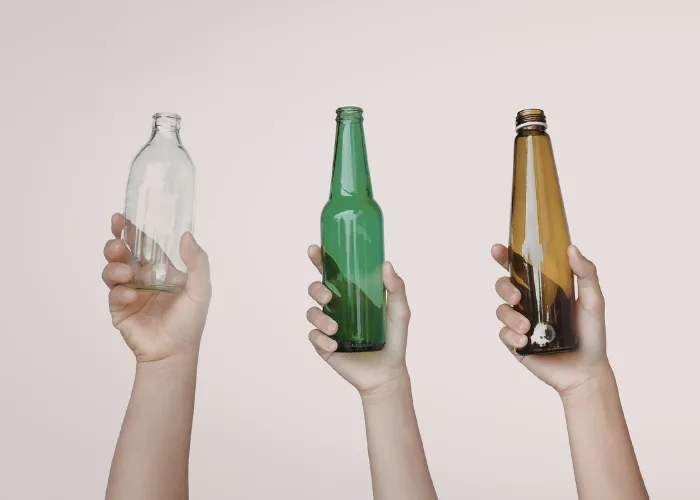
Since 1 January 2025, regulations on the use of disposable plastic containers in France have significantly tightened, with a clear objective: to implement the 3R strategy – Reduce, Reuse, Recycle – for single-use plastic packaging.With nearly 2.75 billion reusable packaging units placed on the market in 2024, across all sectors, reuse is becoming a major societal shift. However, this transition also represents a major innovation challenge for industry.
Reuse to Waste Less: A Regulatory Obligation!
Single-use packaging represents more than 33% of global plastic waste and remains the main source of plastic pollution. One of the most effective ways to reduce this impact is simple: reuse packaging instead of discarding it.
In recent years, French legislation has evolved rapidly to phase out single-use plastics, particularly in collective catering, fast food and takeaway services.
The main binding measures already adopted in France, along with their key deadlines, are listed in the table below:
| Key date | Main measure | Associated Law |
| 1 January 2022 | Home meal delivery:
Ban on disposable cups, plates, cutlery and containers for services delivering more than 4 times per week |
AGEC law (art. 77) |
| 1 January 2023 | Collective catering:
(more than 20 guests at the same time) Ban on disposable tableware for on-site consumption |
AGEC law (art. 77) |
| 15 March 2024 | Creation of an EPR scheme (Extended Producer Responsibility) for out-of-home catering packaging, requiring suppliers to finance end-of-life management | AGEC law (decree of 7 march 2023) |
| 1 January 2025 | School, university and childcare catering:
Ban on plastic containers for cooking, reheating and serving (municipalities under 2,000 inhabitants: postponed to 2028) |
EGALIM law (art. 28)
And AGEC law (art. 77) |
| 1 January 2025 | Takeaway sales in collective catering:
Mandatory use of reusable or recyclable containers instead of disposable packaging |
Climate and Reslience law (art. 24) |
| Horizon 2030 | All packaging placed on the EU market must be recyclable (minimum Grade C) or integrated into reuse systems. Example: 40% of non-alcoholic beverage packaging must be reusable by 2030 | EU Regulation 2025/40 (PPWR) |
What Are the Reuse Targets?
France aims to progressively reduce single-use plastic packaging and relies heavily on reuse to reach the phase-out of single-use plastic packaging by 2040.
However, according to the French Senate, delays in exiting single-use plastics are jeopardising some AGEC Law objectives. Data from ADEME’s National Reuse Observatory show that 2.75 billion reusable packaging units were placed on the market in 2024, representing only 1.82% of all packaging placed on the market.
The target remains ambitious: 10% of packaging must be reusable by 2027.
Reuse: An Emerging Trend
Despite slower-than-expected progress, many positive signals indicate that reuse is gaining momentum, notably through regional pilot projects.
Reuse of Glass Bottles and Jars: CITEO’s ReUse Scheme
After two years of development, CITEO launched ReUse, a model designed to establish a national, shared reuse system for food packaging in retail.
Since June 2025, the scheme has been tested in four regions in north-west France, involving around fifty brands, producers and retailers. More than 250 stores in Brittany, Normandy, Pays de la Loire and Hauts-de-France now offer standardised, open-source reusable glass packaging from CITEO’s R-Cœur range.
The objective is to pool 30 million reusable packaging units by the end of 2026, ahead of national rollout in 2027.
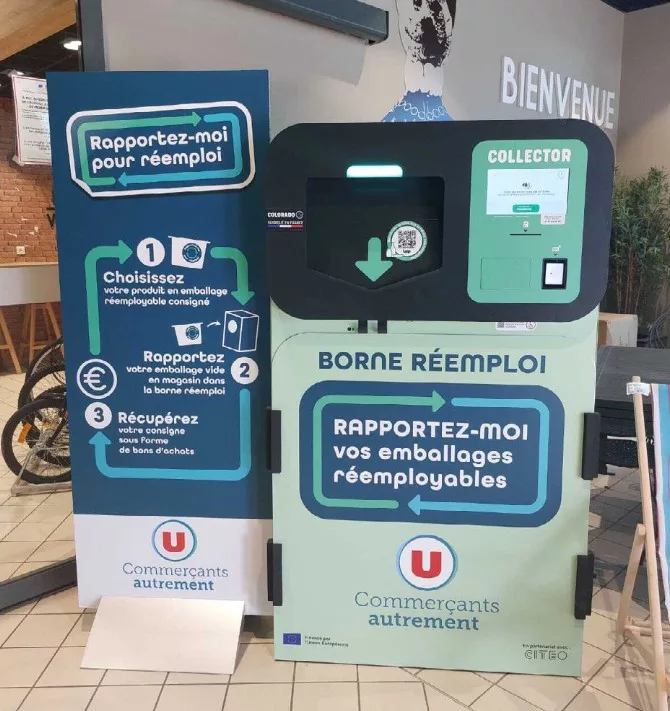
Deposit-Return Reusable Plastic Containers: Carrefour and Coopérative U
In 2024, Carrefour and Coopérative U began testing a deposit-return system for reusable plastic containers for fresh products. The initiative is part of the European Horizon project “Rapportez-moi pour réemploi” (traduction: « bring me back for reuse ») and currently covers around 20 product references across 15 product families, supported by the R3PACK European Consortium, the European Commission, and CITEO.
Stainless-Steel Trays in School Catering: The Toulouse Example
Since the start of the 2025 school year, Toulouse’s central kitchen, producing 35,000 meals per day, has replaced all disposable trays with stainless steel, avoiding 100 tonnes of plastic waste per year.
Meals are delivered to schools in fully stainless-steel containers, with two dedicated washing tunnels: one for lids and crates, the other for gastronorm trays.
Reuse: Industrial Transformations and Challenges
The shift from disposable containers to reusable ones is a challenge for the entire production and distribution chain: for retailers, the food industry, packaging manufacturers, and even label producers.
Standardization
Large-scale reuse requires standardised and pooled packaging formats, implying close collaboration between brands and retailers. Packaging manufacturers are evolving from product suppliers to providers of reusable packaging services.
This also requires collection, sorting and washing infrastructures, and therefore significant investment.
Washing
All reusable packaging requires washing. Logistics apart, dedicated industrial washing facilities are therefore essential.
Example: the future Semelog shared washing plant near Paris (opening in 2026) will process 130,000 containers per day, equivalent to 160,000 meals.
Packaging Traceability
Large-scale reuse also relies on the ability to track each packaging unit.
Example: At Toulouse’s central kitchen, stainless-steel trays are tracked using QR codes and sensors.
Labelling and reuse
Standardised reusable packaging increases the relevance of labelling. CITEO’s pilot deposit packaging uses purple “Return me for reuse” labels, barcodes for deposit scanning, and specific messages for consumers.
This also requires labels that are easily removable during washing and do not interfere with water reuse processes: non-toxic inks, and water-soluble adhesives and labels.
Example: CareTips® water-soluble films are biobased, biodegradable in water, microplastic-free and printable.
Material Durability
Reusable packaging must withstand repeated industrial washing, heat and detergents. This favours materials such as glass, PP, HDPE, stainless steel, and other emerging materials.
Don’t Fall Behind: Choose Innovation!
According to a Xerfi study of household and professional plastic packaging manufacturers:
- 1 in 2 already produces reusable packaging
- R&D investment increased by 8% in 2023 vs. 2022
- Circular economy investment increased by 3%
These figures confirm that reuse is becoming a strategic priority for industrials.
Now is the time to invest in innovation, adapt processes and materials, and prepare for the coming packaging revolution!